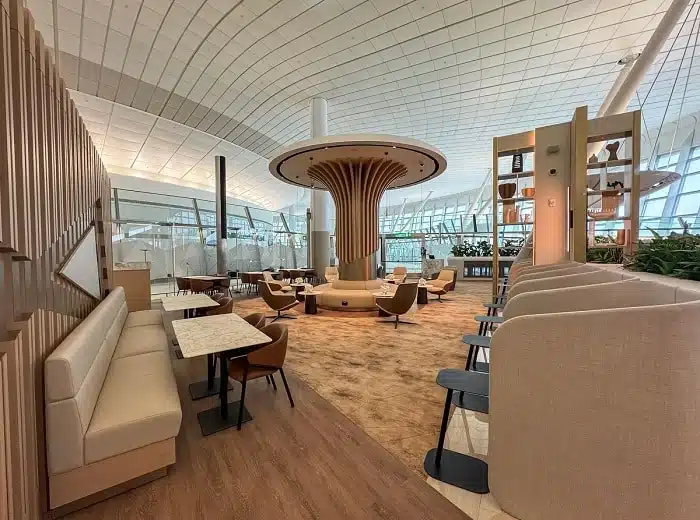
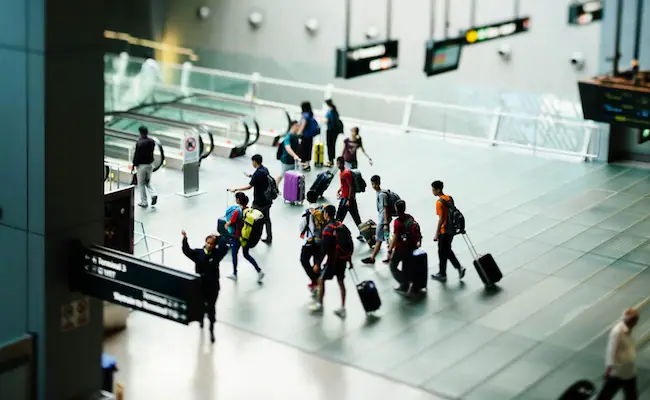
Singapore’s Changi Airport is probably the best place to spend a long layover.Changi Airport was named the world’s best by Skytrax from 2013 to 2020. The airport is a major hub for Singapore Airlines and features luxuries like a pool and a movie theater.
The Skytrain to terminal 3 from terminal 1.
The transit area spans across all four terminals, with 1, 2, and 3 connected via an airside train, while the 4th can be accessed by an airside bus. The unique activities and extravagant shops are mostly located in terminals 1 and 3.
Boasting four huge terminals with endless shopping, food, and entertainment, the airport was named the world’s best by Skytrax for eight years in a row from 2013 to 2020.
Despite losing its crown to Qatar’s Hamad International Airport in 2021, Changi still welcomed over 32 million passengers in 2022 and is planning a fifth terminal to open in the mid-2030s.
After hearing the hype about Changi, I decided to spend eight hours inside exploring everything it has to offer. Here’s what it was like.
Curbside entrance to terminal 3 at Singapore’s Changi International Airport.
Instead of just having a regular departures floor, there was also a huge “underground carnival” in the basement of terminals 2 and 3, and I was instantly eager to explore.
Entrance to the “underground carnival” from Changi’s terminal 3 check-in lobby.
What I found was essentially a huge fun zone that had way more than I was expecting.
One of the restaurants in Changi’s “underground carnival” in terminal 3.
There was a playground for kids, which included a slide…
The playground with a slide at Changi’s “underground carnival” at terminal 3.
…as well as several restaurants and giant shops. The stores were incredible, with everything from groceries and clothes to suitcases and kitchen supplies.
All types of different produce were available, and I saw a lot of people here doing their grocery shopping. There was pretty decor, like chairs and a fountain.
After forcing myself not to buy any of the cool knickknacks, I headed back to the check-in lobby at terminal 3. The space was pretty normal compared to other airports, though it definitely felt cleaner and more open.
Changi’s terminal 3 check-in lobby.
There were huge windows creating natural light and beautiful green plants lined across the back wall.
A view of Changi’s Jewel complex connected to terminal 1.
According to Changi’s associate communications director Lay Ling Toh, 99% of the plants and trees are real and are maintained by a team of horticulturalists.
While the landside area was impressive in itself, most of the fun within Singapore’s famous airport is located in the transit area.
Because Changi is a major hub for Singapore Airlines and its subsidiary, Scoot, the space is important for keeping connecting travelers entertained for hours between flights.
Inside Singapore’s Changi International Airport.
Unfortunately for locals or tourists who just want to visit the airport for fun, only passengers who intend to travel can access the transit area, unless they’re an employee or have another authorized reason to be there.
A sign at Changi that says only passengers that plan to travel are allowed in the transit area, including those who have a boarding pass. This is likely to discourage people from buying a cheap fare just to have fun in the transit area for the day.
When accessing the transit area, I noticed there was no security line, but Toh explained that security takes place at the gate. Travelers just need to scan their passport and boarding pass to enter.
Following three and a half years of extensive engineering and expansion efforts, Changi Airport Terminal 2 is set to fully reopen in November 2023, with a wide selection of new shops, dining establishments, services, amenities, and more. At present, a limited number of retailers are already open to the public. Nevertheless, in the weeks ahead,…
Singapore’s Changi Airport is set to enhance its connectivity with the construction of a 2.5km underground link between the upcoming Terminal 5 (T5) and the existing Terminal 2 (T2). This development, known as the T2 Connection, will feature tunnels housing an automated people-mover system akin to the current Skytrain, alongside a dedicated baggage handling system….
Etihad Airways has launched its new United States Preclearance Lounge at Zayed International Airport, making Abu Dhabi the only Middle Eastern hub to offer this streamlined service. Conveniently located just steps from the US Customs and Border Protection (CBP) Preclearance facility inaugurated in December 2024, the lounge enhances Etihad’s commitment to offering premium travel services….
The Indian government has launched a Fast-Track Immigration Trusted Traveller Programme (FTI-TTP) to enhance the efficiency of international travel. Initially implemented at Delhi’s Indira Gandhi International Airport, the program is set to expand to 20 other airports across India, including major cities such as Mumbai, Chennai, and Kolkata. Key Features of the Fast-Track Immigration Programme…
On Tuesday, April 15, the UAE encountered its heaviest rainfall in 75 years, affecting flights to and from the country. Airport services experienced disruptions, prompting airlines to postpone, cancel, and divert numerous flights. With ongoing repair initiatives and improving weather conditions on Wednesday, some flights and UAE hubs have resumed operations. Operations at Zayed International…
Air India Express has announced that it will be moving its operations to the newly launched Terminal A (TA) at Abu Dhabi International Airport (AUH Airport) from November 1. Abu Dhabi is a key market for Air India Express, and the airline operates 29 weekly departures connecting Abu Dhabi to Calicut, Kannur, Kochi, Mangaluru, Tiruchirappalli,…